
Senior leaders have a due diligence obligation to stay informed about work health and safety (WHS) risks that may affect their operations. However, without visibility into how and why organisations are prosecuted, it can be difficult to fully understand the level of exposure that may exist within your own business.
Reviewing real prosecution outcomes helps bring the standard of reasonably practicable to life. These cases show how regulators and courts assess what organisations should have known, what controls should have been in place, and how decisions are judged based on the likelihood and severity of harm. Even if an incident has not occurred in your workplace, significant cases within your industry should shape your risk management approach.
Since 2015, Action OHS Consulting has systematically analysed prosecution data from WorkSafe Victoria and SafeWork NSW to identify trends, common failures, and emerging risk areas. These insights provide practical evidence to support stronger leadership conversations, more informed investment decisions, and a more proactive WHS strategy.
To support this review, we have compiled prosecution data from:
This article examines WHS prosecution outcomes from 2015 through to 2025, equipping your organisation with the perspective needed to anticipate risk, strengthen controls, and stay aligned with regulatory expectations.
Prosecutions: Numbers and related legislation
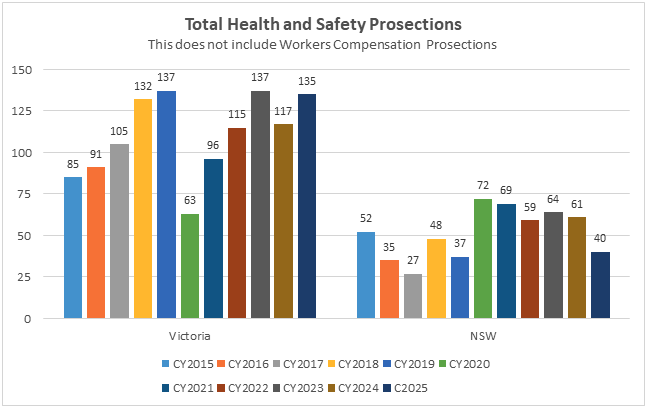
The 2025 calendar year saw a total of 135 prosecutions against the Victorian health and safety legislation, whilst in NSW the number of prosecutions was 40.
Victoria: There has been a 15% increase in Victoria compared to the previous year. This increase aligns the prosecution number to a similar number as in CY2023. This also returns the prosecution to the same numbers seen pre-COVID, as CY2018 and CY2019 reported 132 and 137 prosecutions, respectively.
NSW: To be updated once the full year data is available.
Prosecutions
Within Victoria:
- 113 prosecutions were recorded against the Occupational Health and Safety Act 2004 only.
- 19 prosecutions involved the Occupational Health and Safety Act 2004 and the Occupational Health and Safety Regulations 2017.
- 3 prosecutions were recorded against the Dangerous Goods Act 1985.
Within NSW:
- Up until September 2025 all prosecutions were against the Work Health and Safety Act 2011 only.
Prosecution timeframes
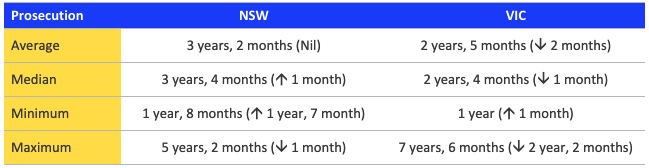
The table below lists the timeframe for the prosecution’s outcomes from 2025 when measured against the date of the offence.
Table 1: Timeframe between date of offence and the prosecution outcome, for the 2025 prosecution outcomes reported by SafeWork NSW & WorkSafe Victoria. Bracketed numbers represent the increase / decrease from 2024.
Health and safety fines
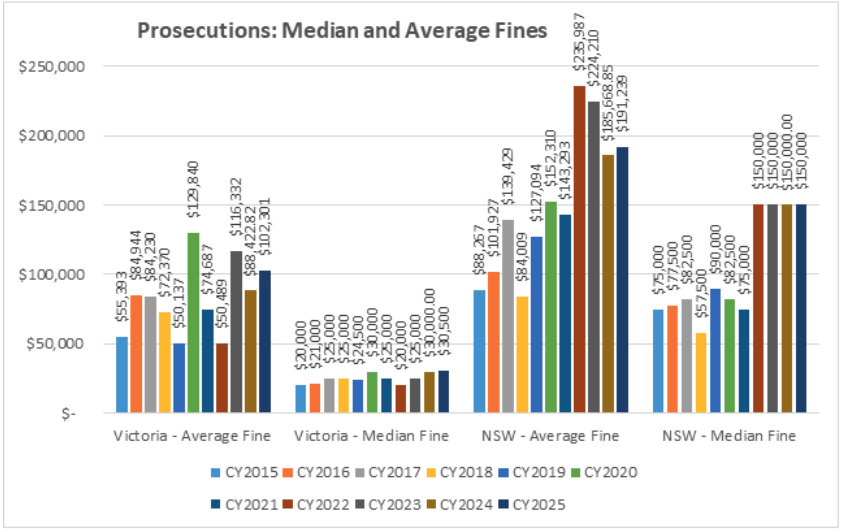
In Victoria, penalty levels have continued to trend upward, with the average fine increasing by 17% compared to CY2024. The median fine has also edged up slightly, rising from $30,000 to $31,000, reflecting consistency in enforcement outcomes. The number of significant penalties has increased, with two (2) fines exceeding $1 million in CY2025 compared to one (1) in CY2024, noting there were three (3) in CY2023.
In New South Wales, the average fine remained broadly in line with CY2024, while the median penalty has held steady at $150,000 since CY2022. Despite this stability, the overall penalty environment in NSW remains higher than in Victoria.
When comparing jurisdictions, both the average and median fines in NSW continue to exceed those issued in Victoria. The average penalty in NSW is now approaching twice the Victorian average, and the median fine is more than five times higher, reinforcing the comparatively stronger financial consequences for non-compliance in NSW.
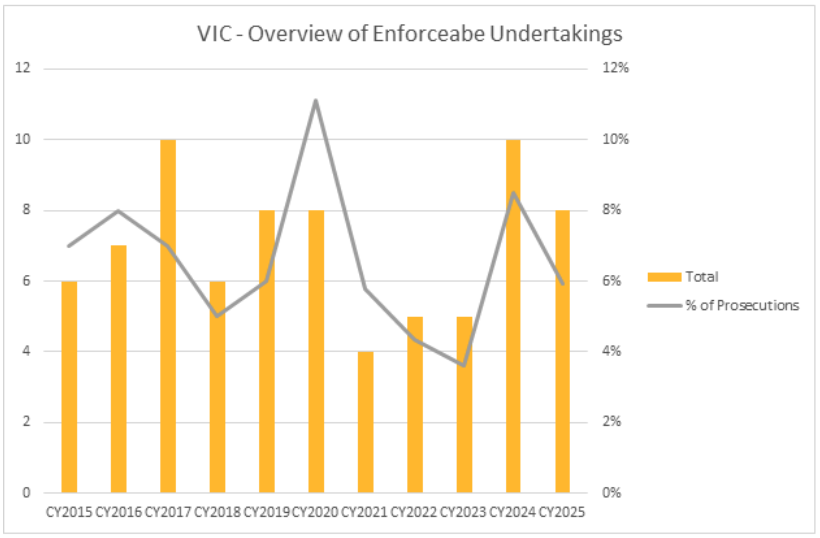
WorkSafe Victoria reported issuing eight (8) Enforceable Undertakings during CY2025, which equates to 5.9% of prosecutions. This is less than the number of Enforceable Undertakings issued in CY2024 which was ten (10).
Health and safety fines: Maximum issued.
The maximum fine in Victoria for CY2025 was the highest it has been across the 10 years that this review has been undertaken. With NSW, given not all the data has been accessible, this will be reviewed again, all data has been accessed.
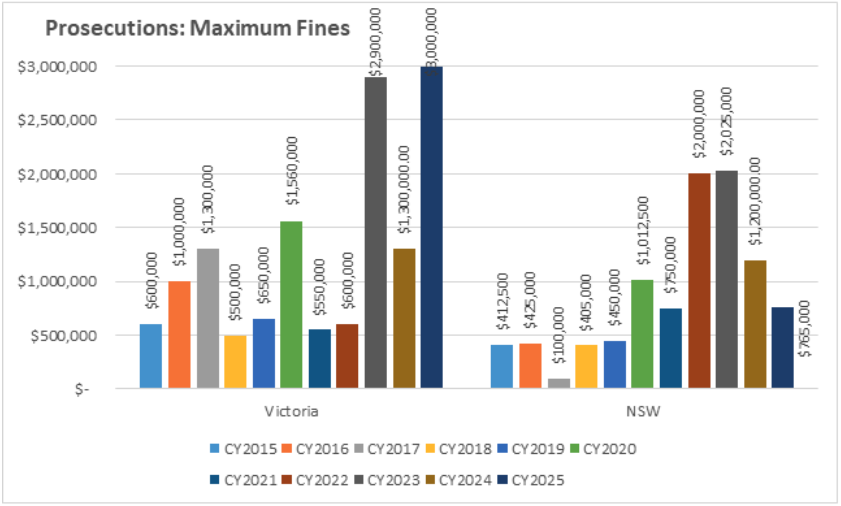
The maximum fines issued to a business were associated with the following events:
Victoria:
LH Holding Management Pty Ltd, a stonemasonry business in Somerton, was fined $3 million after a worker was fatally crushed when the sole director operated a forklift across a slope with a high, swinging load while the worker stood nearby assisting. The court found the company breached its duty of care by failing to operate the forklift safely—specifically by not keeping the load low, reversing on a slope, maintaining exclusion distances, and avoiding turning across an incline—conduct that directly caused the death. While the director showed remorse, cooperated with WorkSafe, and had no prior convictions, the courts emphasised the seriousness of the negligence and the need for strong deterrence, with the Court of Appeal increasing the original $1.3 million fine to $3 million for manifest inadequacy.
Note, due to the appeal, this incident is the same as was reported in CY2024.
NSW:
On 27 January 2021, a worker sustained fatal injuries when the cables of a crane used to lift a submerged yacht broke and fell onto him. After a SafeWork NSW investigation the defendant, AWB Contractors Pty Ltd, was charged with a breach of section 32/19(1) of the Work Health and Safety Act 2011. On 23 July 2025, the defendant was convicted by the District Court and fined $765,000.
It is not just businesses that are being prosecuted in relation to health and safety breaches.
Health and safety prosecutions are not limited to corporations. In CY2025, 7% and 20% of prosecutions were issued to workers in Victoria and NSW, respectively – equating to 10 and 8 prosecutions, respectively.
In both Victoria and NSW, this is consistent with the 10-year trend.
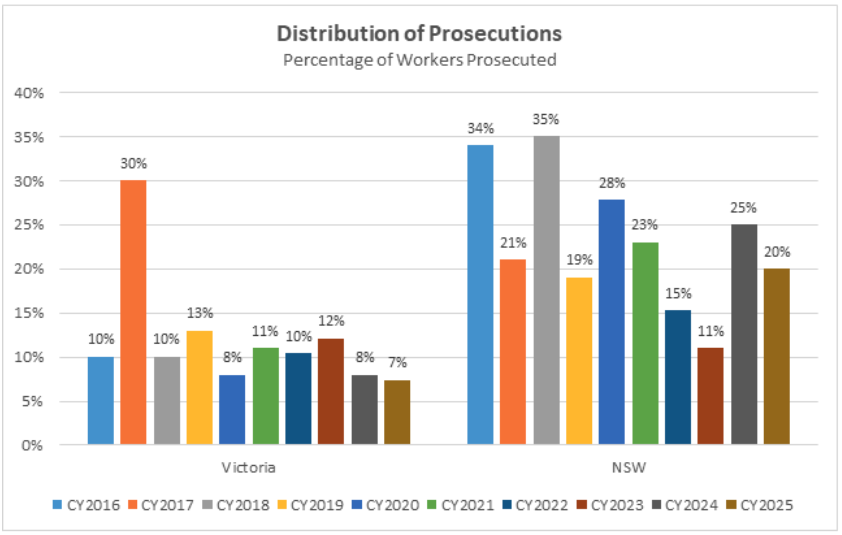
The average fine issued to a worker in Victoria and NSW was $20,250 and $33,731, respectively.
Prosecutions: What is the cause and where are the gaps?
As defined by WorkSafe Victoria, with respect to the criteria/codes that lead to the prosecution, of the 61 criteria that were referenced, 14 criteria were associated with more than 10% of the prosecutions in CY2025. These are outlined below.
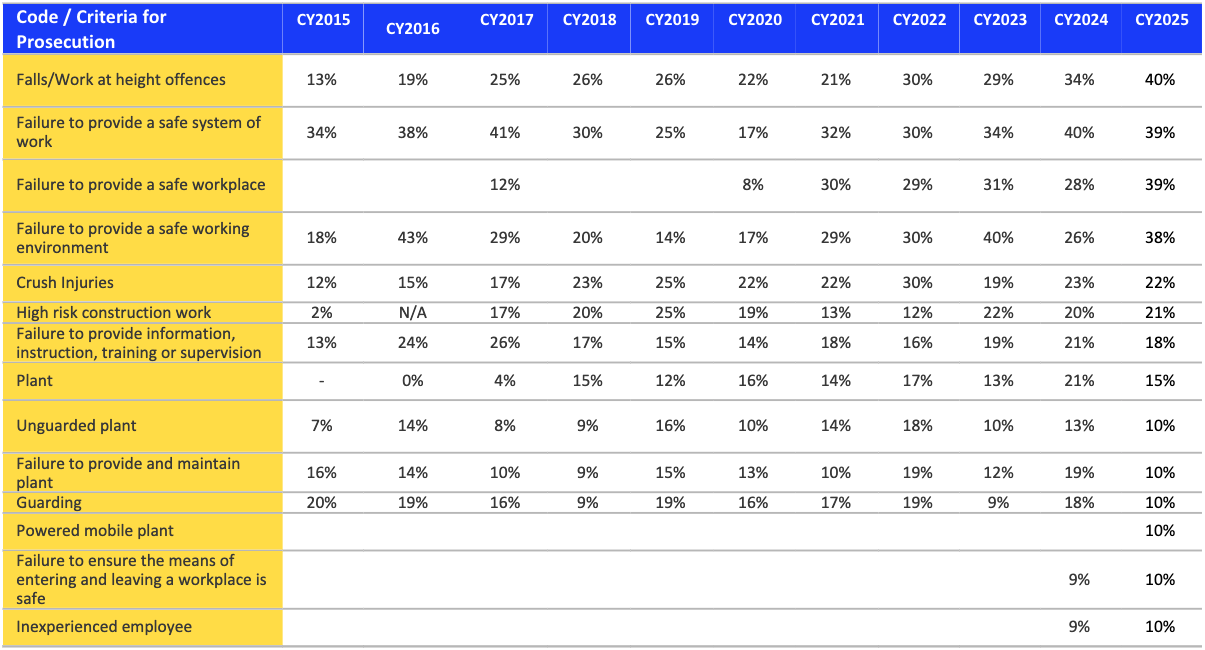
While the distribution shifts each year, the underlying themes have remained consistent since 2015. “Falls / work at height”, “Failure to provide a safe system of work”, “Failure to provide a safe workplace”, and “Failure to provide a safe working environment” continue to make up the consistent top four (4) offence categories. Together, these reinforce a clear expectation on organisations to understand their operations, identify the hazards associated with their work, and ensure that effective controls are established, implemented, and maintained.
With recent increased regulatory focus on psychosocial hazards and silica exposure, it will be important to monitor how these emerging priorities are reflected in future prosecution activity. In CY2025, prosecutions referencing these areas remained relatively limited: Silica (1), Workplace bullying/harassment (5), Occupational violence and aggression (1), Stress (0), and Sexual harassment (0). While numbers remain low, the regulatory attention in these areas suggests this may shift in the years ahead.
Health check
Action OHS Consulting, in collaboration with its sister company Safety Champion Software, has developed a self-assessment tool the: Safety Champion Impact Assessment. The tool helps businesses identify potential points of failure and areas of exposure, enabling proactive improvements to their health and safety program. Access to the assessment will be available until 30 April 2026.
Free consulting support
Through the WorkSafe Victoria OHS Essentials Program, eligible Victorian businesses may access three (3) OHS consulting sessions delivered over a 12-month period by an Action OHS Consulting consultant. These sessions are designed to help organisations understand and meet their legal OHS duties and obligations.
Free webinar support
For those who prefer online guidance, Action OHS Consulting developed a four-part webinar series focused on helping businesses understand and manage their legal health and safety responsibilities. This still holds context now. The full War on Safety series is available to access free of charge.
Assessing the Effectiveness of Your Health and Safety Program
Make safety accessible. Ensure policies and procedures are clear, practical, and relevant to day-to-day operations. Systems such as Safety Champion can help manage scheduled activities, incident reporting, and hazard visibility.
Identify your critical risks. Document the Top 5 hazards that could cause the most serious harm and confirm the controls that are in place and working. Engage workers across dissimilar roles to validate assumptions. Need support? We can assist.
Maintain ongoing consultation. Regularly involve workers through toolbox talks, safety meetings, and informal conversations to identify gaps and drive continuous improvement.
Build capability and confidence. Provide structured inductions and refresher training so workers understand both safety expectations and operational risks. Consider mentoring for new or young workers.
Ensure program sustainability. Avoid reliance on a single individual, spreadsheets, or disconnected folders. Centralised systems provide visibility, accountability, reminders, and data to support informed decision-making. Hint. Nudge. Safety Champion.
Integrate safety into business decisions. Assess safety risks before purchasing new equipment, engaging contractors, or changing processes to prevent introducing unmanaged hazards.
Access external expertise when capability is limited. Where internal safety resources or experience are limited, structured support such as Safety Champion Assurance+ provides access to a fractional safety manager who delivers ongoing governance, independent oversight, and practical guidance to help you meet your legal obligations and maintain a sustainable safety program.
If you would like to strengthen your approach or test the effectiveness of your current controls, Action OHS Consulting can provide support aligned to your business size, risk profile, and internal capability. Feel free to connect-in or contact us.
Author: Craig Salter
Data Prepared by: Katie Larkin